
Creating Molecular Probes to Study Interactions in Biology
Welcome to the website of the Butler Research Group. We are based in the Chemistry Department at Loughborough University. Research in the Butler Group is focused on the synthesis of supramolecular tools to probe interactions at the chemistry/biology interface. We are developing fluorescent and luminescent molecular probes for the selective detection of biological substrates. We are applying these probes to monitor biological processes in real-time, such as tracking enzyme activity in vitro and in living cells, to facilitate the discovery of new potent drugs.
Our research is multidisciplinary in nature, spanning organic synthesis, physical organic chemistry techniques, molecular recognition, optical spectroscopy, bioassay development and cellular imaging.
If you are interested in joining the Butler Group please contact Steve for an informal discussion about opportunities, or if you would like to apply for external funding to join the group. We are always looking for keen scientists to join our team!

Latest News
Peroxynitrite Detection at Membrane Interfaces

July 2026
Congratulations to Jamie and Rebecca on their first publication! 🎉 Their work introduces a membrane-targeted europium(III) probe for the selective detection of peroxynitrite, providing a new tool to study this short-lived species at membrane interfaces.
Dual-modal MRI-luminescence Nanoparticles

July 2026
Congratulations to Caty on her second publication from her PhD thesis! 🎉 This work presents a bimodal MRI–luminescence nanoparticle platform, which display both high relaxivity and long-lived luminescence, offering a promising approach toward more effective dual-modal imaging agents.
Anion Recognition and Sensing Review Paper

May 2026
A review in Chem. Sci. highlights advances over the past five years in lanthanide host design, showing how these developments have improved mechanistic understanding of binding and enabled new anion sensors and imaging probes that function in aqueous and biological media. Congratulations Christy!
Group Away Day!

May 2026
The group enjoyed a day out of the lab, with competitive games of foot-golf and mini-golf.
Lanthanide Tags for EPR and Luminescence Applications

January 2026
Our latest paper in ChemistryEurope introduces a series of lanthanide tags that label cysteine, each showing high chemoselectivity for cysteine and enabling labeling in aqueous solution under mild conditions. The findings highlight the critical role of linker design in lanthanide-based probes for EPR spectroscopy and biological imaging. Congratulations Lydia!
MASC 2025
December 2025
Several members of the group attended Macrocyclic and Supramolecular Chemistry (MASC) conference in Milton Keynes.
Steric and geometric tuning of Eu(III)-based Anion Receptors

September 2025
Our latest paper in Chem Eur. J. presents four new macrocyclic Eu(III) complexes and demonstrate how ligand structure and positional tuning of π-conjugated antennae modulate steric demand and anion binding site geometry. This enables size and shape complementarity for selective ADP recognition in water over competing phosphoanions.
PhD and MChem Graduation Day
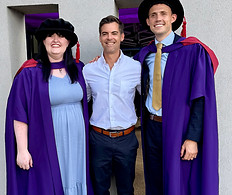
July 2025
We are delighted to congratulate Hannah Pyle and Jamie Webb on their PhD graduations, and Hannah Gurney on completing her MChem degree — fantastic achievements all round!
Congratulations, Prof. Butler!

July 2025
Well done to Steve who was promoted to Professor in Synthetic Supramolecular Chemistry. Much Deserved!